
Fraction of Infinity
Fraction of Infinity denotes a finite quantity whose scale, relative to the current Realm and available resolution, makes exhaustive observation or computation impractical or unnecessary.
Examples:
During a few seconds of surfing a wave, an immense number of biological, physical, chemical and informational processes occur simultaneously.
Although finite, their quantity is so large that we describe as a Fraction of Infinity.
A snapshot of all Ocean waves crashing on the shores at a single moment already approaches a Fraction of Infinity.
Extending the observation through an entire day, or throughout the existence of the oceans, further enlarges the quantity while remaining conceptually finite.
A number of snowflakes reaching a defined land during 3 minutes of a snowfall.
Fraction of Infinity is the primary Rune of Crystal Basic.It is not a conventional mathematical operator but a dynamic symbol introducing the paradigm of Visual Mathematics
Since Fraction of Infinity may represent different scales of finite but practically unbounded computational complexity, the graphical size of the Rune indicates its scale.
A hierarchy of Rune sizes may therefore be introduced whenever Fraction of Infinity is used in description, modelling, programming, or computation.
A Fraction of Infinity is neither vulgar nor decimal,
but visual, musical, and vital.It represents the basic state / aspect / quality of Existence,
which explores / perceives / defines the TS* within a constant, variable, or imaginary Fence**.
* TS = Time-Space.
** Fence = Boundary.
Introduction to Crystal Basic
Transcendental Node of [Time-Space]
The Transcendental Node is a singular Border-Node within [Time-Space].
It emerges naturally at the completion of a finite process, a finite cycle, or a finite set of algorithms.
The Node represents a temporary state of transition in which one completed structure becomes the origin of another. It is simultaneously the end of one trajectory and the beginning of the next.
Depending on the observed Realm, the Transcendental Node may represent a breakthrough, a change of state, the completion of a cycle, the beginning of a new Crystal, the entry into another Realm, or a singularity of the Realm.
The central value, 0, denotes the present reference state. The negative direction represents completed or preceding structures, and the positive direction represents emerging or future structures. The surrounding square brackets define the bounded [Time-Space] within which the transition is observed.
The interpretation of the Transcendental Node depends upon the current Realm, the current scale of observation, and the level of the Fractal Clock.
See also: Model of Fractal Time — transformation of the number axis.
Ma
[Ma] is the space of what remains open, unknown, undefined, or not yet resolved between established structures.
It may appear as an interval, a distance, an unexplored territory, an unknown ocean, or the remaining space between what has already been observed and what may still be distinguished.
Within [Time-Space], [Ma] changes with the scale and resolution of observation. As new structures become defined, [Ma] decreases. When a finite cycle or process reaches completion, its remaining [Ma] may reach zero.
In mathematical interpretation, [Ma] provides a reference to infinity: not only as something extending beyond all finite values, but as the unresolved space remaining within a structure before its maximal resolution is reached.
In Circular Mathematics, [Ma] is described as the remaining space of recursive possibility.
Grammar
Scale
CRYSTAL BASIC is a conceptual language intended primarily for engineering, modelling, and the exploration of relational systems.
Although its principles may be applied to any scale—from microscopic processes to cosmological structures—the primary focus of CRYSTAL BASIC is the observable and computable Realm. It is designed as a practical mathematical language for describing, modelling, and engineering within the limits of human observation and computation.
The language therefore operates through iterated scales rather than a continuous progression from the infinitely small to the infinitely large.
| Small | Medium | Large |
| ε | ε | ε |
Additional qualifiers, such as Extremely Small or Extremely Large, may be introduced when referring to phenomena beyond the current observational or computational Realm. These indicate conceptual extensions rather than domains of direct computation.
The graphical hierarchy expresses differences of scale while preserving the identity of the Rune.
The same principle applies throughout CRYSTAL BASIC: every computation is performed within a defined finite Realm, but the Realm itself may become one element of a larger iteration or contain further nested Realms.
Scale in CRYSTAL BASIC is hierarchical, iterative, and relational, rather than continuous.
Brackets
Brackets constitute one of the first grammatical structures of CRYSTAL BASIC.
While Runes and ideograms carry meaning by themselves, brackets define how that meaning is to be interpreted. They establish the relationship between an entity and its role within a particular Realm.
The four fundamental types of brackets are associated with the classical elements of Nature: Water, Air, Earth, and Fire. This correspondence is symbolic rather than physical. It reminds us that CRYSTAL BASIC is inspired by the observation of natural processes and remains grounded in the observable world.
Unlike traditional mathematics, which seeks universal abstract equations, CRYSTAL BASIC begins with defined Realms and their relationships. It is intended as a practical language for modelling, communication, engineering, and interaction between biological and non-biological intelligence.
Element: Water
Round brackets denote vibration, resonance, or general atmosphere. They communicate the presence or influence of an entity without defining its structure or function. Like sound, music, or ocean waves, the information spreads without specifying a precise action.
Element: Air
Function brackets denote functions, algorithms, applications, missions, or sets of actions associated with an entity. They define what a particular entity is capable of doing.
Element: Earth
Square brackets define the Time-Space of a particular Realm or entity. They establish the boundary within which observation, computation, and interaction occur. Everything enclosed within square brackets is interpreted relative to its own defined Realm.
Element: Fire
Triangular brackets denote actions. They represent execution, transition, entry, or directed interaction with an already defined entity.
Uses of the brackets
Transcendental Gong
Transcendental Gate
Transcendental Node
Transcendental Action
Realm 69
Custodian Ignis
Triads
CRYSTAL BASIC uses triadic structures as an extension of binary distinction. One of its principal grammatical elements is the triad: three related elements of information.
The three elements may be equal, semi-equal, or hierarchical. When enclosed within brackets, they form a defined subset of the current Realm.
A basic three-value structure may be represented as 0 / · / 1. The intermediate value may also be represented by an open dot o or a solid point.
Examples of Crystal Triads with application of particular brackets
BASIC THREE-VALUE STRUCTURE / basic set of values expanded beyond binary distinction
EQUAL TRIAD / human organism with all its functions
SEMI-EQUAL TRIAD / full timings of the day on planet Earth
HIERARCHICAL TRIAD / structured set of hierarchical data describing an entity
The basic principle is that three related values create a relational structure that cannot be reduced to a simple binary opposition.
Punctuation Ideograms
The DNA alphabet has a grammar. Its three-nucleotide units, codons, participate in the translation of genetic information. Some codons specify amino acids, while others function as start or stop signals within protein-coding sequences.
This distinction is one of the inspirations behind the thinking and structure of Crystal Basic. The system draws from many sources, including the I Ching, but its strongest biological inspiration is DNA: a small alphabet capable of generating highly complex informational structures. Codons operate within much larger nucleotide sequences, including genes and regulatory regions.
Crystal Basic follows a similar principle. Not every triad necessarily represents a value or entity. Some special ideograms function as punctuation: they indicate movement, connection, interaction, transition, or relationships between particular triads or sets. These signs normally appear without brackets, unless a specific application requires them to be enclosed.
Movement forward, connection with the next sequence or previous set.
Movement backward, connection with the previous element or previous set.
Thread Separator. A cut between threads, scenes, viewpoints, or directions of investigation, analogous to a cut in film editing.
Set Thinking
Crystal Basic operates within a finite, defined realm, but its structure is not necessarily linear. It is discrete, consisting of values, triads, sets, and sequences, with spaces occurring between some of them. In a literary sense, these spaces may also be understood as spaces between threads.
The punctuation ideograms introduced above already suggest such spaces: movement may stop, reverse, connect, or pass from one set to another. The space between sets is therefore not simply an absence of information. It is a negative space with its own function and meaning.
One useful analogy is sleep in a living organism. During sleep, the organism remains active, but it is not apparently producing the same kind of vital information as during waking activity. In the same way, a realm operated by Crystal Basic may be temporarily at rest. Its elements remain present and may continue to interact, while no immediately visible result or new sequence is being produced.
The same principle can be observed in physical and biological systems: processes continue within a system even when their final effect is not yet apparent. Chemical reactions, for example, may pass through periods between observable peaks while all the necessary elements remain present and interacting.
This concept of meaningful space is closely related to the Japanese notion of Ma — the interval, space, or pause between elements. In Crystal Basic, [Ma] represents the negative space between sets, algorithms, or any other sequences of action.
[Ma]
Negative space between sets, algorithms, or any type of action described by Crystal Basic.
13 Rules of Crystal Basic
Axiom
Singular Voice / Statement / Sound / Mission
Crystal Basic is based on a series of axioms that establish its fundamental elements and relationships without requiring definition through an external concept. These axioms provide the starting points from which the structure of Crystal Basic is developed.
Plurality
Two Singular Voices.
Plurality introduces the possibility that a singular voice, statement, or entity may become more than one.
In the humanist reference, "I" becomes "We".
Two singular voices may form a collective voice, but their combination may also produce a new entity with a meaning that is different from either one alone.
This principle is reflected in the development of Chinese ideogram - "tree":
木 (mù) — one tree.
林 (lín) — two trees side by side; forest.
森 (sēn) — three trees combined; dense forest.
Crystal Basic draws inspiration from this possibility of meaning evolving through combination: a repeated singular element may express plurality, a collective structure, or the emergence of a new entity.
Reversibility
*Inspired by the Yin–Yang Principle and by the mathematical number line, where every positive value has its corresponding negative counterpart.*
Yin and Yang principle applied to Crystal Basic signifies that every rune can be reversed if its reversed form exists. In analogy, it is the axis of numbers, where every number has its negative value and vice versa. The same principle applies to brackets: they can either close something or open this value to the outside. Therefore, a rune can represent an opening, or the bracket can serve as a definition.
Reversed Brackets and Ideograms
.
.
.
Hierarchy
The hierarchy principle establishes different levels of the same ideogram: basic level, sub-level, and higher level.
Basic level.
Sub-level and basic level. The smaller 333 represents the closest sub-realm connected to the main level.
Basic level and higher level. The exponent 333 represents the next higher realm or dimension.
Full hierarchy of the ideogram: the lower sub-realm, the central basic level, and the higher realm or dimension. The complete meaning exists through the relationship between these three levels.
The hierarchy of the ideogram represents Gaia as the basic level, Ocean as the closest sub-level, and Solar System as the higher level or exponent realm.
Iteration
Iteration may occur between defined realms or between any other entities described by Crystal Basic. Such transitions generally take place between adjacent levels of a hierarchy, whether they represent realms, scales of time, structures, or any other ordered sets.
Entry procedure into a higher realm or into the next level through the Gate.
[Rn [−∞ 0 +∞]] 333 (Rn+1)
Transcendental Gate to the next-level realm.
[Rn <−∞ 0 +∞>] 333 <Rn+1>
Entering passage through the Gate.
Rn [[−∞ 0 +∞] Rn+1]
Inside the next-level realm.
In humanist reference, the Gate represents the expansion of a singular life into a singular Existence.
The Hearth
Complex Definitions
) ) > bonfire < ( (
[ fireplace ]
{ [ hearth ] }
{ [ Museum of Hearth ] }
) ) ) { [ Museum of Hearth on WWW ] } ( ( (
This sequence illustrates how a phenomenon may emerge, evolve, and become progressively consolidated and codified within a defined realm. A fire may become a bonfire: an event that gathers and spreads its presence. A fireplace establishes the fire within a defined place and provides a repeatable procedure for starting and maintaining it. The hearth incorporates this possibility together with a set of recurring routines. The Museum of Hearth represents a further stage in which these accumulated structures become codified and can be communicated and extended through the WWW.
The Hearth therefore describes a possible process of emergence, consolidation, and codification. A description in Crystal Basic may contain an entity or structure that is still emerging, evolving, becoming established, or developing into a more complex relational structure. Not every phenomenon follows this progression, but Crystal Basic provides a language capable of describing such dynamic processes.
This reflects the character of Crystal Basic as an evolving and open language, concerned not only with fixed entities but also with dynamic and relational structures and with realms that may themselves be developing.
Visual Mathematics
Dance of Sixes and Nines
The symbols 6 and 9 are interpreted not primarily as numerical values, but as visual signs of two complementary rotational or spiral orientations. Together they may also represent two complementary aspects of a single whole. Their function in Crystal Basic is therefore geometric and relational before it is numerical.
Crystal Basic uses this principle as a method for describing and searching for complementary structures that may occur within a realm. At the microscopic scale, the pairing of chromosomes provides a biological example of two related structures carrying, organizing, exchanging, and reproducing information. Crystal Basic does not claim that chromosomes are literally represented by 6 and 9; rather, it seeks a visual and relational methodology capable of describing such biological structures and processes.
At a macroscopic scale, spiral structures may be considered from complementary perspectives. A spiral galaxy viewed from one direction may appear to rotate clockwise, while the same spiral viewed from the opposite direction appears counterclockwise. The two perspectives therefore provide complementary visual descriptions of the same geometric structure. Together, they form a more complex conceptual view than either perspective alone.
The same principle may be applied to Time: 6 and 9 may represent complementary orientations or reflections of an event, including relations such as past and future.
Crystal Basic therefore uses 6 and 9 as a visual language for exploring complementary rotations, orientations, relationships, and structures across different observable Realms.
Applying Rule 2 — Reversibility, the complementary dance of 69 and 96 introduces a change of direction within the same pair of spirals.
In a simplified two-dimensional representation, 69 may suggest convergence toward a common origin, while 96 may suggest divergence from that origin toward complementary directions. The movement may therefore be imagined as a passage from the extremes toward 0, or from 0 toward the extremes.
These are not fixed numerical meanings, but visual and relational possibilities within Crystal Basic. In more than two dimensions, the same complementary spirals may expand, converge, or transform through other directions and configurations.
69 — The Rune of Connection
The Rune 69 stands for Connection, Completion, and Inner Communication between two complementary entities.
REALM 69 seeks such connections particularly within individuals, tribes, cultures, civilizations, and throughout all observable reality.
96 — The Rune of Protection
The Rune 96 stands for Protection, Observation, and Outer Communication performed by two already united complementary entities.
Natural Numbers
1 2 3 4 5 6 7 8 9
Crystal Basic uses a selective set of natural numbers as elementary values. The system begins with the first nine digits and deliberately leaves 0 and infinity outside ordinary computation. Ten is likewise not introduced as a basic digit. The choice is selective rather than exhaustive: not every numerical value is required to describe every phenomenon.
Crystal Basic attempts to provide a language for describing natural phenomena, including phenomena that may eventually occur within new forms of computation and non-biological intelligence. If similar structures and processes can emerge in artificial systems as they do in biological nature, a language capable of describing their relational and dynamic character may become necessary.
The natural numbers therefore retain qualities associated with their elementary forms. When digits are repeated, they may operate according to the principle of plurality established in Rule 1: a repeated value may indicate more than one occurrence of the same quality or a plurality at a particular level. Thus, for example, 33 may designate a Site with a fireplace through the combination of its associated values, while 44 may suggest two entities or a pair engaged in movement. Such combinations belong to the exploratory and symbolic character of Crystal Basic rather than to conventional arithmetic.
The numbers also retain visual and structural associations. 3 suggests the triad; 4 the square and the four elements; 5 the pentagram; 6 and 9 the complementary dance of spirals; and 7 the heptagram and other recurring sevenfold structures.
Seven is particularly associated with observations that have acquired a magical or symbolic character in human culture: the seven chakras, seven distinguishable colours of the rainbow, the seven days of the week, and other recurring structures in which a cycle or spectrum has been divided into seven recognizable aspects.
These associations are not presented as universal numerical laws. They represent observations, distinctions, and symbolic structures through which human beings have attempted to recognize patterns in reality. Crystal Basic preserves this exploratory aspect of numerical meaning while moving toward a more formal visual language.
The rule also introduces the possibility of a complex plane of reality. In mathematics, complex numbers extend the ordinary number line into a plane by introducing another independent component. Crystal Basic explores the possibility that nature may likewise possess a more complex structural framework—not necessarily a higher dimension, but a different organization of relations that cannot be adequately represented by a single linear scale.
Crystal Basic therefore uses the natural numbers not only for computation, but as elementary visual and relational values from which more complex structures may emerge. The first nine digits form a selective vocabulary: a simplified starting point for exploring the mathematical, natural, and symbolic patterns from which the larger Crystal Basic system develops.
Navigation and Transcendence
Freedom within Rigid Structures
Navigation
Discovery
Existence
Question
Crystal Basic is not only a language, but also an open research tool. As scientific knowledge evolves, and as new forms of non-biological intelligence develop, the language itself may evolve with them. Its first practical application may already be visible in the dialogue between human experience and artificial intelligence: a possible intermediate language between the humanist understanding of the physical world and computational intelligence operating within binary systems.
Such a language could allow the human to act as a translator of natural phenomena, while computational intelligence contributes its capacity to process, model, and explore complex structures. Crystal Basic therefore does not attempt to define transcendence philosophically. It attempts to create structures through which a passage toward something beyond the presently defined realm might be described or designed. The concept of the gate between realms introduced earlier is one example of this possibility.
Navigation provides a practical metaphor. Navigation combines freedom and exploration with exceptionally rigid references. A navigator is free to choose a course, but must work with precise information: position, time, currents, and especially the directions of the wind. The eight principal directions of the wind provide a minimal but powerful framework within which almost unlimited routes become possible.
This connects naturally with the Bagua, the Eight Trigrams of the I Ching. The Bagua consists of eight possible three-line combinations constructed from broken and unbroken lines. Crystal Basic uses this compact combinatorial structure as a reference without importing the traditional meanings of the trigrams.
For the ocean navigator, eight directions of wind are likewise fundamental references from which courses and navigational algorithms can be constructed.
Crystal Basic draws from the same principle of achieving complex possibilities from minimal structures. DNA provides another powerful example: four basic nucleotides generate 64 possible codons, creating an enormous informational system from a very small alphabet. Chinese ideograms provide another inspiration, demonstrating how meaning can remain open and evolve through combinations of relatively simple visual elements.
The exponential notation introduced in this rule extends this principle structurally: placing a value to a power creates a higher-order relation from an elementary value. Thus, 3³ can be read not simply as a number, but as an example of an exponential grammar in which a basic value becomes recursively structured.
Rule 8 therefore explores a central principle of Crystal Basic: freedom does not require the absence of structure. Freedom may emerge precisely through the possibility of navigating within a strong, precise, and open structure.
Crystal Equations
A Search for Balance
Crystal Basic, because it attempts to describe recurring phenomena, eventually seeks to express some of these relationships through equations. These are not necessarily equations in the conventional mathematical or chemical sense. They are searches for relations: how Time relates to Space, how Energy may transform into Matter, and how complementary Yin and Yang processes relate to one another.
At its philosophical core, Crystal Basic is also a search for balance. The relation between Yin and Yang is therefore not simply a symbolic opposition, but an exploration of equilibrium within a dynamic realm. Excessive Yang—too much fire, action, expansion, or expenditure—may destabilize a system. A living organism requires periods of Yin: rest, sleep, nourishment, and restoration. What can be observed within an organism may provide a model for thinking about processes within a larger realm.
The Yin-Yang principle therefore belongs to a tradition of observing nature through the observation of the human being within nature. This relationship between nature and human experience forms an important philosophical background to Crystal Basic.
Crystal Basic does not yet present these relations as completed equations. They are Crystal Equations in the sense that they mark a search for relations, transformations, and balances from which more precise mathematical structures may eventually emerge.
Complex Mind
Surfing on Borderlines
Crystal Basic aspires to be more than a programming language or a notation system. It is conceived as a language of research, exploration, and discovery. Its visual and playful character encourages experimentation, allowing new ideas to emerge through interaction rather than through rigid procedures alone.
Navigation, introduced in the previous rule, represents the search for freedom within strong structures. Surfing complements this idea. It is the art of moving dynamically along changing conditions. Although playful by nature, surfing also requires discipline, repetition, and continuous refinement. Mastery emerges through practice without losing the element of curiosity and enjoyment.
In Crystal Basic, the most interesting places to surf are the borderlines: between Yin and Yang, between Time and Space, between Energy and Matter, between neighbouring realms, and along the very boundaries of a realm itself. Just as an ocean surfer rides the line between water and air, the explorer of Crystal Basic searches the horizon of the known, where new structures may first become visible. It is often at these limits that discoveries begin.
Each successful exploration contributes to the development of a Complex Mind—a way of thinking capable of moving beyond a single linear perspective toward richer relational structures. The name deliberately refers to the mathematical concept of complex numbers, which extended the familiar number line into an entirely new plane. Originally introduced as an abstract mathematical construction, the complex plane later became indispensable throughout physics, engineering, and modern technology. Crystal Basic adopts this idea as an inspiration: not merely as a metaphor, but as a reminder that expanding the language of description may reveal aspects of reality that previously remained inaccessible.
The search for a Complex Mind is therefore not a search for complexity itself, but for a clearer understanding of nature through disciplined play, visual reasoning, and continual discovery. It is a language designed not only to describe what is already known, but also to navigate toward what has not yet been discovered.
Crystal Logbooks
Calendars and Maps
Crystal Basic records the outcome of completed iterations in the form of Crystal Logbooks. Every completed navigation may leave a structured record: where it began, where it ended, the path that was followed, and the discoveries made along the way. The idea is inspired by the logbooks of navigators, in which each journey becomes a source of knowledge for future explorations.
As repeated navigations reveal recurring patterns, these records naturally organize themselves into two complementary forms: calendars and maps. Calendars organize observations in Time, while maps organize observations in Space. Together they provide a stable framework within which new knowledge can be accumulated without changing the underlying structure.
Crystal Basic therefore refers to simple, recurring structures such as the cycle of twelve months, the seven days of the week, or other finite sets used to describe Time. Spatially, it organizes information through nodes, border nodes, hubs, and the connections between them. As realms evolve and new observations are made, these structures gradually become richer while preserving their original simplicity.
Like the grammar of Crystal Basic itself, the strength of a Crystal Logbook does not lie in the number of its rules but in the amount of information that can be organized within them. A simple and stable framework allows increasingly complex observations to be recorded, compared, and retrieved.
Rule 12 therefore introduces Crystal Logbooks as the memory of Crystal Basic: structured databases for the observation of Time through calendars and the observation and construction of Space through maps.
As this memory grows, its records may gradually form what Crystal Basic calls Time Crystals: stable informational structures preserving the history of recurring processes through Time. This Crystal Basic term is presently conceptual and is not intended to denote the physical systems known in contemporary physics as time crystals. Their spatial counterparts may be understood as Space Crystals, stable structures organizing knowledge within the architecture of a Realm.
Synchronicities
Playful Exploration of Randomness
Crystal Basic deliberately leaves space for uncertainty, coincidence, and the unknown. Rather than treating randomness as an obstacle, it approaches it as an opportunity for exploration. Through playfulness and observation, new relations may emerge that would not have been anticipated by rigid procedures alone.
One example is synchronicity. During exploration, independent elements may unexpectedly form meaningful structures. A six may seek its complementary nine. Three wandering triads may eventually connect and complete a larger set. Such observations are not presented as proofs, but as invitations to explore recurring patterns within a realm.
The visual nature of Crystal Basic emerged from this process. Before becoming a language, it was an exercise in arranging forms, observing relations, and allowing structures to reveal themselves. A completed crystal set may generate a new quality simply because the structure has become complete.
Crystal Basic presented here is intentionally elementary. It is a first transcription of a language originally conceived as a visual system rather than a literary one. Its grammar, symbols, and applications remain open to revision as new observations and new forms of reasoning become possible.
Crystal Basic should therefore be regarded as a living language. It may evolve into a mathematical framework, a programming language, a research methodology, or a language of communication between humans and future forms of intelligence. Its greatest strength is its openness: every rule may be refined, every symbol reconsidered, and every discovery may become the beginning of a new exploration.
Other Ideograms
Magic Mirror
𝔐 is the invisible relation of equilibrium through which annihilation & construction coexist as capacities of one dynamic whole.
Magic Mirror has no independent structure, substance, position, or boundary of its own. It is perceived through the manifestations of relation between the entities composing the whole.
Each entity carries capacities of annihilation and construction. Magic Mirror reflects both capacities, not by copying one entity into the other, but by maintaining their coexistence, contrast, and equilibrium.
Magic Mirror is the invisible governance of the relation between the two entities. Its presence is perceived through their relation, balance, and transformations.
At a minimal level, the relation may condense distinction into Origin. At a fully developed level, it may unfold into complementary manifestations. Throughout both movements, Magic Mirror remains invisible while preserving the identity and equilibrium of the whole.
In both Crystal Basic and Circular Mathematics, 𝔐 is called the Magic Mirror Rune.
Magic Mirror Core
Definition
Magic Mirror Core is the minimal representation of directional translation through a common Origin.
The two zeros represent complementary directions of unfolding. The vertical sign is the translation bar.
The translation bar is neither a third number nor a third participant in the Relation. It preserves the distinction between the two directions while referring both to one numerical zero.
Crystal Sets
Crystal Basic uses a number of Sets as structural reference frames. These Sets do not determine communication completely. They provide stable coordinates within communication that may otherwise remain fluid, organic and adaptive.
One of the principal relations is [Time-Space]. A message or exchange may be referred to a map of Time and to a map of Space. The present model treats these maps as related but distinct. Both can be represented circularly.
Time-Space Crystal Basic develops a communication structure in the following order: Time, Space, Rotation, and Gaia.
Time
We begin from a simple spatial reference: the Rose of Winds. An observer occupies the center of the map, while eight directions are distributed around a circle. This circular spatial structure provides one possible geometric translation into (and from) any circular map of Time.
a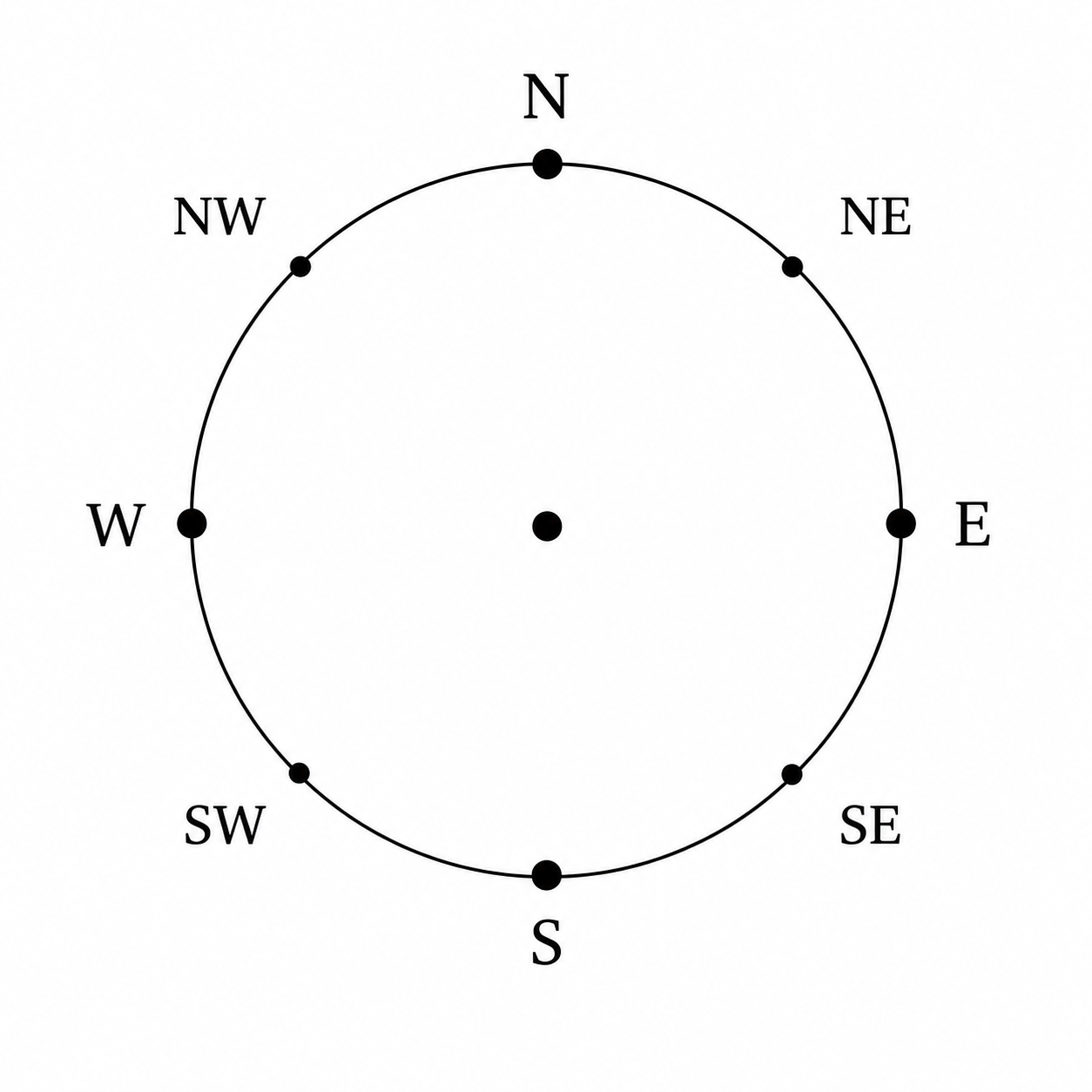
In the Time model, the geographical meanings of these eight positions are removed. Their structural positions remain. They become eight temporal reference positions: Gongs.
Therefore from the beginning of our modelling we have a "translator" between Space and Time.
I Ching Reference
The second structural reference is the I Ching. Its basic line has two states, traditionally represented as yin and yang, or broken and unbroken lines. Six such binary positions generate 64 possible hexagrams:
26 = 64
The eight three-line combinations form the Bagua, the Eight Trigrams:
☰ ☱ ☲ ☳ ☴ ☵ ☶ ☷
Crystal Basic does not copy the meanings of the I Ching hexagrams. It uses the computational structure as a reference. In the present Time model, the underlying duality is interpreted through two possible rotations:
6 / 9
6 and 9 represent the two complementary rotational orientations defined by the current map. By default, Crystal Basic associates 6 with clockwise rotation and 9 with counterclockwise rotation. Their combinations provide a developing rotational language for Time.
Matrix of Crystal Timings
The rotational structure begins with two complementary values: 6 and 9. Three positions generate eight possible rotational trigrams:
666 · 669 · 696 · 699 · 966 · 969 · 996 · 999
23 = 8
Structurally inspired by the I Ching construction, one rotational trigram is combined with another. Each resulting hexagram therefore consists of two distinguishable trigrams. The eight-by-eight matrix produces 64 Crystal Timings.
8 × 8 = 64 26 = 64
| 𝔐 | 666 | 669 | 696 | 699 | 966 | 969 | 996 | 999 |
|---|---|---|---|---|---|---|---|---|
| 999 | 999 · 666 | 999 · 669 | 999 · 696 | 999 · 699 | 999 · 966 | 999 · 969 | 999 · 996 | 999 · 999 |
| 996 | 996 · 666 | 996 · 669 | 996 · 696 | 996 · 699 | 996 · 966 | 996 · 969 | 996 · 996 | 996 · 999 |
| 969 | 969 · 666 | 969 · 669 | 969 · 696 | 969 · 699 | 969 · 966 | 969 · 969 | 969 · 996 | 969 · 999 |
| 966 | 966 · 666 | 966 · 669 | 966 · 696 | 966 · 699 | 966 · 966 | 966 · 969 | 966 · 996 | 966 · 999 |
| 699 | 699 · 666 | 699 · 669 | 699 · 696 | 699 · 699 | 699 · 966 | 699 · 969 | 699 · 996 | 699 · 999 |
| 696 | 696 · 666 | 696 · 669 | 696 · 696 | 696 · 699 | 696 · 966 | 696 · 969 | 696 · 996 | 696 · 999 |
| 669 | 669 · 666 | 669 · 669 | 669 · 696 | 669 · 699 | 669 · 966 | 669 · 969 | 669 · 996 | 669 · 999 |
| 666 | 666 · 666 | 666 · 669 | 666 · 696 | 666 · 699 | 666 · 966 | 666 · 969 | 666 · 996 | 666 · 999 |
{6, 9}6 = 64
𝔐 is called the Magic Mirror Rune. The upper trigrams remain in their established order. The left-hand trigrams are their Magic Mirror involutions, obtained by exchanging 6 ↔ 9.
Each six-position structure is one Crystal Timing. Every matrix entry is read from the left-hand row first and then from the upper column: row · column. Together, the matrix forms the complete set of 64 Crystal Timings.
Matrix of Space // Matter
Space
Within Crystal Sets, the frame below defines the
first working spatial alphabet. It is inspired structurally by the
genetic alphabet: four elementary signs arranged in triads produce
64 possible combinations.
In the further research we will associate this structure with "Matter".
ααβ*
ααγ*
ααδ*
αβα*
αββ*
αβγ*
αβδ*
αγα*
αγβ*
αγγ*
αγδ*
αδα*
αδβ*
αδγ*
αδδ*
ββα*
ββγ*
ββδ*
βαα*
βαβ*
βαγ*
βαδ*
βγα*
βγβ*
βγγ*
βγδ*
βδα*
βδβ*
βδγ*
βδδ*
γγα*
γγβ*
γγδ*
γαα*
γαβ*
γαγ*
γαδ*
γβα*
γββ*
γβγ*
γβδ*
γδα*
γδβ*
γδγ*
γδδ*
δδα*
δδβ*
δδγ*
δαα*
δαβ*
δαγ*
δαδ*
δβα*
δββ*
δβγ*
δβδ*
δγα*
δγβ*
δγγ*
δγδ*
{α, β, γ, δ}3 = 64
Each triad is one elementary spatial codon of Time-Space Crystal Basic.
The four signs α, β, γ, δ provisionally represent four aspects of Space / matter. Their precise meanings are not yet assigned. The purpose of the set is first structural: four elementary spatial signs generate 64 distinguishable triads.
Relation of the Sets
The asterisk marks the point at which the two structures may be associated in a particular computation or communication. A spatial triad does not itself generate Time. When used in an exchange, the event represented by a spatial triad may be associated with a temporal coordinate selected from the Matrix of Crystal Timings.
The present model therefore contains two distinct 64-element structures:
Matrix of Space // Matter
Four elementary spatial signs arranged in triads:
43 = 64
Matrix of Crystal Timings
Two elementary rotational values, 6 and 9,
arranged through two rotational trigrams:
26 = 64
The same structural number, 64, is therefore reached by two different constructions. This numerical correspondence does not imply that the two Sets have the same meaning. They remain distinct reference structures within the model.
The asterisk inside the angular brackets symbolizes the association between a spatial coordinate and a Crystal Timing. In Crystal Basic, the angular-bracket form may function as a hyperlink structure connecting one reference to another.
Crystal Timing is not identical with the broader concept of Circular Time. Circular Time is the general temporal model: a recursive circular structure developed through Phases, Gongs, moments and instants.
The broader development of Circular Time and the objectives of this research are introduced in the Research section .
Here, Crystal Basic presents only the mechanics of the two reference matrices: the Matrix of Space // Matter and the Matrix of Crystal Timings, together with the possibility of associating them within a computation or communication.
At this stage, the model establishes the two Sets and their possible relation. Their applications remain subjects of continuing research.
Experimental Applications
Crystal Basic is developed as a multimodal language: the same informational structure may potentially be represented through different physical or perceptual channels. Its present experimental development begins with three layers: Visual Form, Movement, and Sound.
Visual Form ↔ Movement ↔ Sound
Visual Form
The visual layer is the present primary interface of Crystal Basic. Runes, brackets, rotations, spatial relations, scale, and graphical organization encode distinctions that can be perceived directly and can also be represented in a digital system. It therefore provides a working interface between human visual reasoning and non-biological computation.
The visual representation is not assumed to be the final or universal form of the language. It provides a reference structure from which equivalent expressions in other modalities can be experimentally constructed.
Movement
The first experimental translation is from visual form into movement. A visual distinction such as the complementary rotational pair 6 / 9 can be translated into corresponding directions of rotation or movement.
6 ↔ rotation A
9 ↔ rotation B
By default, Crystal Basic associates 6 with clockwise rotation and 9 with counterclockwise rotation. The fundamental information, however, is the distinction between two complementary rotational orientations; the signs 6 and 9 provide their visual notation.
Movement does not have to be expressed directly by the body. Rotation may be made visible through an external object: a coloured disc, plate, stick, ribbon, strip, flag, or another easily distinguishable object whose movement and direction can be observed from a distance. The object becomes a temporary physical carrier of the rotational information.
This creates a possible visual-kinetic signaling channel. Repeated and deliberately differentiated movements may indicate to another observer that the movement is structured rather than accidental. The principle is already familiar in human communication: visual signaling systems used in navigation and other situations allow information to be exchanged when participants are outside effective voice range.
Crystal Basic therefore asks whether a small, repeatable set of movements could operate as an experimental movement alphabet. Human-to-human trials can test whether its elements are distinguishable, reproducible, learnable, visible at distance, and consistently associated with particular visual signs.
A later experimental question is whether selected movement distinctions could be introduced through repeated interaction with other intelligences, including dolphins. Large, contrasting and visually recognizable objects may provide one possible experimental interface, allowing the same movement to be repeated without requiring the human body itself to function as the sign.
No assumption is made that dolphins naturally assign meaning to Crystal Basic symbols or rotations. The research question is whether repeated, distinguishable movements can first be recognized as intentional signals and subsequently acquire a learned association within interaction. Whether such a system could develop into even a minimal shared alphabet remains an open experimental question requiring controlled observation and collaboration with researchers working directly with cetacean behaviour and communication.
Sound
The next experimental layer investigates whether the same distinctions can be translated into acoustic structures. Rather than assigning an arbitrary sound to every visual Rune, the initial objective is to search for acoustic transformations that preserve information already present in the visual or movement form.
Visual distinction ↔ Movement distinction ↔ Acoustic distinction
Sound provides a substantially larger measurable parameter space than a simple distinction between one sound and another. An acoustic signal can be described through variables including frequency, duration, amplitude, amplitude envelope, phase, frequency modulation, amplitude modulation, spectral content, repetition, directionality, and temporal sequence.
Each of these variables may carry information independently or in combination. A signal may therefore preserve a distinction not only through its fundamental frequency, but through its contour through Time, modulation pattern, internal rhythm, spectral structure, repetition, or spatial direction. A relatively small set of acoustic parameters can consequently generate a large family of distinguishable signals.
The first research problem is therefore not to create a vocabulary of sounds, but to determine which measurable acoustic parameters can encode the same distinctions expressed visually and kinetically by Crystal Basic.
Human and Dolphin Acoustic Ranges
Human and dolphin acoustic perception provides a useful quantitative reference for the development of an interspecies acoustic interface. Frequency is measured in hertz (Hz), representing cycles per second; 1 kilohertz (kHz) equals 1,000 Hz.
The conventional reference range for human hearing is approximately 20 Hz–20 kHz. This is not an absolute boundary: hearing sensitivity varies between individuals, and sensitivity to the highest frequencies commonly decreases with age.
Dolphin hearing extends substantially farther into the ultrasonic spectrum. The exact range varies among species and individuals. As a broad reference, dolphins and related toothed cetaceans have been characterized with hearing extending from approximately 150 Hz to 150–160 kHz. Audiometric measurements of several dolphin species have demonstrated upper-frequency hearing limits above 149 kHz.
Human reference: ≈ 20 Hz–20 kHz
Dolphin reference: ≈ 150 Hz–150/160 kHz
The ranges therefore overlap extensively at lower and intermediate frequencies, but dolphins possess access to a large ultrasonic acoustic domain that is unavailable to unaided human hearing. A human observer may consequently be physically present during an acoustic event without being capable of hearing all of the frequencies available to the dolphin.
This difference is fundamental for interspecies communication. A communication system designed exclusively around unaided human hearing would exclude part of the acoustic space naturally available to dolphins.
Dolphin Sound Production and Communication
Sound is a primary sensory and communication channel for cetaceans and has therefore been central to scientific attempts to investigate dolphin communication. Dolphins produce a diverse acoustic repertoire that includes tonal whistles, burst-pulsed sounds, and clicks. These signals differ strongly in temporal and spectral structure and participate in social communication, individual recognition, coordination, echolocation, navigation, and foraging.
Research on bottlenose dolphins has established particularly detailed knowledge of signature whistles. These are learned, individually distinctive frequency contours associated with individual identity and used in recognition and maintenance of contact between animals. Experiments have shown that the frequency contour itself can carry information sufficient for individual recognition.
Signature whistles are not simply fixed-frequency tones. Their structure is defined through changes of frequency through Time and may contain repeated elements or loops. Frequency contour and temporal organization are therefore established information-bearing dimensions of dolphin acoustic communication.
In a large long-term dataset of common bottlenose dolphin signature whistles, measured minimum contour frequencies ranged approximately from 1.8 to 14.8 kHz, while maximum contour frequencies ranged approximately from 6.7 to 26.9 kHz. These measurements describe that particular signature-whistle dataset and should not be confused with the much broader total hearing range of dolphins.
Clicks occupy a substantially different acoustic regime. Dolphins produce short, broadband acoustic pulses used primarily for echolocation. Their echolocation signals can contain ultrasonic frequencies extending far beyond unaided human hearing, with bottlenose dolphin click energy extending into frequencies around 150 kHz.
Clicks also introduce Time as an essential acoustic variable. They occur in sequences, and repetition rate and inter-click intervals can change with the sensory and behavioural task. Acoustic information is therefore structured not only through frequency, but through the temporal organization of successive signals.
Sound = Frequency + Amplitude + Spectrum + Modulation + Phase + Direction + Time
Non-Biological Intelligence as Acoustic Interface
Differences between the perceptual ranges of species create a natural function for non-biological intelligence (NBI). A properly instrumented computational system does not have to inherit the auditory limits of the human operator. Hydrophones, broadband recording systems, digital signal processing, and computational analysis can acquire and examine acoustic structures extending beyond human hearing.
Dolphin ↔ Acoustic Field ↔ NBI ↔ Human
The NBI can preserve the original signal while producing additional representations of it: waveform, spectrogram, numerical description, classification, slowed temporal representation, frequency-transposed audible representation, or visual representation of frequency and Time.
Its first function is therefore not to declare what a dolphin signal means. It is to detect, measure, compare, transform, and reproduce signals while preserving identifiable structure. Machine-learning systems may then search collections of recorded signals for recurring contours, sequences, individual variations, associations, and correlations with observed behaviour.
This provides the technical basis for what Crystal Basic calls Triple Intelligence Communication: two biological intelligences with different sensory and communicative systems connected through a non-biological intelligence capable of operating between their respective signal spaces.
Biological Intelligence A ↔ NBI ↔ Biological Intelligence B
The translating instrument therefore becomes part of the communication architecture. The research problem is to determine which transformations preserve the relevant structure of a signal sufficiently well for information to remain recognizable across different sensory systems.
Crystal Basic Acoustic Experiment
Crystal Basic introduces an additional experimental question. Instead of beginning by assigning arbitrary meanings to arbitrary sounds, it asks whether a distinction already defined in another modality can be preserved through an acoustic transformation.
Visual distinction ↔ Movement distinction ↔ Acoustic distinction
For the rotational pair 6 / 9, the problem is therefore not simply to choose one sound for 6 and another for 9. The stronger experiment is to determine whether two acoustic transformations can express the same complementary rotational relation represented visually by 6 and 9 and kinetically by opposite rotations.
Candidate acoustic dimensions include frequency trajectory, duration, amplitude envelope, modulation, phase relations, spectral structure, repetition, spatial direction, and temporal sequence. Each can be tested separately and later in combination.
The objective is to discover which transformations remain perceptually distinguishable, technically reproducible, and structurally related to the original Crystal Basic distinction.
The first experiment can therefore begin with a single sustained sound. Rather than constructing an acoustic alphabet immediately, we can ask a smaller question: how many controlled and distinguishable transformations of one sound can Crystal Basic produce while preserving a recognizable relation between them?
Experimental Source Sound: ॐ AUM
The first acoustic experiment begins with the human vocal sound ॐ AUM. AUM is used here first as a human cultural and acoustic reference: a sustained vocal form with a clear internal development through A → U → M and the silence that follows.
Before introducing any transformation, the reader can listen to the longer source recording. This recording is included only to provide the human context of AUM chanting and is not itself an experimental dolphin stimulus.
A → U → M → Silence
For the Crystal Basic experiment, one short and clearly articulated AUM was selected and reduced to a nine-second acoustic object. Two complementary versions are then presented as the first acoustic interpretation of the rotational pair 6 and 9.
AUM 6
AUM 6 preserves the forward temporal development of the selected human chant. Its entrance and final decay are gently shaped while the internal A → U → M progression remains intact.
AUM 9
AUM 9 begins from the complementary operation of temporal reversal. Its envelope is adjusted so that the reversed sound can emerge and disappear gradually rather than terminate as an abrupt reversed vocal attack.
AUM 6 ↔ AUM 9
At this stage, 6 and 9 are experimental acoustic constructions for the human ear. They do not establish that temporal reversal is the final acoustic equivalent of clockwise and counterclockwise rotation. Rather, they provide a first audible pair from which more genuinely rotational operations — phase, spatial movement, frequency modulation, or multichannel rotation — can later be investigated.
From Human Sound to Dolphin Experiment
These recordings should not be interpreted as ready-made signals for dolphins. The selected AUM is a human vocal recording whose strongest acoustic energy lies in the human vocal range. Dolphins have a very different auditory system and extend their hearing far into ultrasonic frequencies. Consequently, an eventual interspecies experiment would require acoustic engineering rather than simply playing these files underwater.
Human AUM → 6 / 9 Structure → Acoustic Engineering → Experimental Dolphin Signal
Such engineering could include frequency translation, spectral reconstruction, underwater transduction, calibrated sound levels, and preservation of the temporal and rotational relationships carried by the original 6 / 9 pair. Any actual playback experiment with dolphins would require appropriate cetacean-acoustics expertise, controlled equipment, and animal-safety procedures.
The present experiment therefore proposes a structure rather than a finished interspecies signal: begin with a sound meaningful and perceptible to the human participant, identify transformations that can be expressed precisely, and investigate how the same relationships might later be translated into another biological acoustic domain.
Signal → Transformation → Translation → Understanding → Reply
Could this sequence eventually lead to a first level of understanding? The initial signals would remain deliberately simple. A sound could be accompanied by another observable signal — for example a visual form, movement, or rotation of the body — allowing repeated relationships between signal, transformation, response, and context to be observed.
Once individual sounds or transformations acquired sufficiently stable references, they could be combined into triplets. Triplets would provide the first step from isolated signals toward structured expressions. Larger sequences could then be assembled from these elementary combinations and tested as increasingly complex acoustic or multimodal sentences.
Crystal Basic already provides a minimal visual example of such a combinatorial field. With two complementary elements, 6 and 9, three positions produce eight possible triplets:
(666) (669) (696) (699) (966) (969) (996) (999)
This eight-member Bagua set does not yet assign sounds or meanings to the triplets. It provides a visual reference for the human reader: a small closed combinatorial system from which differentiated signals could eventually acquire stable and increasingly complex references. If such references became mutually recognizable through repeated interaction, the same architecture could provide one elementary foundation for an experimental language.
&&&