Tak mało wiem o oceanie, mikrodrobinę całeczki nieskończoności...
Coasts
The coast is the first meeting point between two great spaces of Earth: the ocean and the land. Although there is one interconnected Ocean, there are countless coasts — each one a unique fragment of the infinite relationship between water, earth, life and time.
Benoît Mandelbrot introduced a revolutionary way of looking at natural forms through fractal geometry. His famous question, "How Long Is the Coast of Great Britain?", published in Science (1967), became one of the fundamental examples showing that the length of a natural boundary depends on the scale at which we observe it.
The coast is therefore not a line. It is not a finite boundary,
but rather a changing edge that becomes more complex the closer we look.
This is a good example of what we call a
fraction of infinity
.
We can never walk all the coasts of Earth, nor fully experience all
their forms, but we can study their properties, patterns and
relationships.
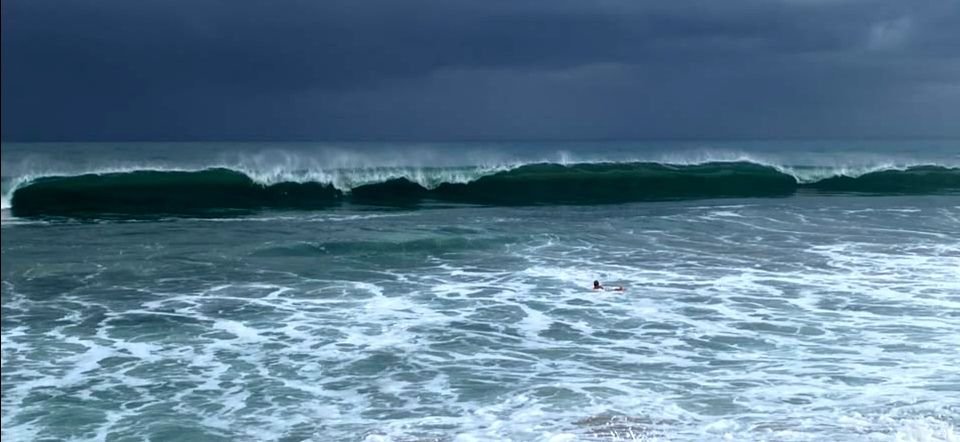
Our particular focus is on the accessible coast: beaches and coastal spaces where humans can enter into direct contact with the Ocean — by boat, by swimming, by body surfing or by surfboard. These places are traditionally destinations of rest and recreation, but they can also become training spaces and research spaces.
The study begins from this planetary proportion: approximately three quarters of Earth's surface is covered by water, while only one quarter is land. In a remarkable reflection, the human body itself follows a similar relationship — composed mostly of fluids, with the solid structures existing within this greater oceanic environment.
The coast becomes our starting field: a living laboratory between Earth and Ocean, between the finite and the infinite, where we begin exploring patterns, cycles and connections.
Space of the Tides
Tides are one of the most visible expressions of the relationship between Earth, the Moon, and the larger planetary system. The gravitational interaction between celestial bodies creates rhythmic movements of the oceans, producing cycles of rising and falling waters that have shaped coastal environments throughout the history of the planet.
The Space of the Tides — Espacio de las Mareas — is the object of our particular study of the fractal qualities of the coast. It is a special zone which sometimes belongs to the ocean and sometimes belongs to the beach, while at the same time belonging fully to neither. It is a boundary-space where two different realities continuously meet and transform each other.
When we study reality from the perspective of energy, the land represents a relatively stable structure: the bones, muscles, and tendons of the planetary body. The ocean represents another type of energy: fluid, mobile, and constantly changing. The coast is the place where these two forms of existence interact.
This interaction creates a unique dynamic field where beaches are built, destroyed, and rebuilt; where waves break, matter moves, and sand transforms into pebbles and rocks. The coastline is not a static border, but an active process of continuous transformation.
The Space of the Tides also reveals that reality does not always exist in linear time. This particular realm appears through phases, rhythms, and recurring timings. By observing nature, we discover not one continuous flow of time, but multiple temporal patterns that emerge through cycles and interactions.
Therefore, the Space of the Tides becomes an entry point for studying the deeper interaction between human beings and nature: a living laboratory where matter, energy, space, and time meet.
Cycles
The movement of tides is one of the fundamental rhythms of the coastal world. The tides are mainly generated by the gravitational interaction between the Earth and the Moon, with additional influence from the Sun and the geometry of the planetary system. Although we often speak about a regular tidal cycle, the exact timing is not a simple six-hour mechanism.
In many places around the world, including the western coast of the Pacific, there are usually two high tides and two low tides during approximately one lunar day. The timing shifts continuously because the Moon does not return to the same position relative to the Earth every 24 hours, and because local geography, coastline shape, ocean depth, and currents modify the rhythm.
The highest expansion of the sea is called pleamar in Spanish: the moment of high tide. The opposite extreme, when the ocean retreats to its lowest level, is called bajamar: low tide. These moments are not only measurements of water level. They are important transitions that define how humans can interact with the ocean.
For swimmers, surfers, and especially body surfers, these cycles become practical knowledge. During low tide, water becomes shallower and certain areas become more dangerous because the distance between the moving body and the underwater structure is reduced. From the perspective of wave riding, one of the observations is that the most favorable conditions often appear around the transition period: approximately two hours before and two hours after low tide, depending on the local beach and wave conditions.
The knowledge of timing in nature is not unique to the ocean. Traditional hunters observe similar relationships in forests and mountains. They know the influence of the full moon and the new moon, the activity of animals during different periods of the night, and the special transitions of dawn and dusk. The environment communicates through rhythms.
The cycles of the ocean reveal a similar principle. The exact hours are not fixed, and the same event may occur at different moments of the day, but there is a recognizable pattern of repetition and transformation. The rhythm of the tides shows a kind of self-similarity with other natural cycles: different scales and different systems can express related patterns of change.
This observation becomes the foundation for a deeper investigation of time and natural rhythms. Before creating theoretical models, we begin with direct observation: watching, swimming, navigating, and recording the interactions between the human organism and the ocean.
My body is my ship and a laboratory of these interactions. Through thousands of hours in the ocean, I collected information through direct experience: the movement of water, the timing of waves, the changes of conditions, and the responses of my own organism. My boat became an extension of this exploration, carrying me through the ocean environment while my body remained the primary instrument of observation. These observations became the foundation of my personal database of ocean interaction.
Log Into
Entering the ocean begins with a simple human activity: being on the beach. For many people, the coast is a place of rest and contemplation. They spend their holidays and free time simply being there, observing the ocean, reading, relaxing, or enjoying the atmosphere of the shore. Children naturally explore this environment. They discover endless creative possibilities in the waves, sand, and coastal landscape.
Among beach users, some enter into more active relationships with the ocean. Swimming, surfing, diving, sailing, kayaking, and many other activities become ways of interacting with this environment. Yet swimmers and body surfers remain a relatively small group compared with other forms of coastal activity.
Entering the ocean, even for an experienced swimmer, is an act of awareness. We are entering a space where we can be injured or even lose our life. The ocean has its own dynamics, its own forces, and its own conditions. Every person entering the water should recognize this relationship and approach it with respect.
The ocean can be calm and welcoming. There are places and moments when the level of danger is very low. However, the fundamental attitude should remain one of consciousness. For less experienced swimmers, entering with a guide or experienced companion is strongly recommended.
From my observations, swimmers and body surfers are a small minority among ocean users. Surfers usually share an area as a group, while a body surfer or a swimmer is often alone in the water. This solitude makes preparation, knowledge, and conscious practice even more important.
The expression Log into refers not only to entering the water physically, but also to entering a different information space. Humans are terrestrial beings: bipeds adapted to walking on solid ground, connected with the stability of the Earth's surface and familiar with its gravitational conditions.
The ocean represents another realm. It is a dynamic environment governed by movement, currents, waves, and changing conditions. Entering the ocean means entering an environment which is not our original habitat — an unfamiliar information space requiring new forms of awareness and adaptation.
Through further studies, I explore the idea that the ocean is not only an information space, but an almost alien information space for terrestrial humans. Perhaps, through a deeper reconnection with our human-dolphin roots, we may rediscover a different relationship with this realm. But as bipeds, we enter the ocean from another world and require a process of translation between these two forms of existence.
This is why logging into the ocean is such an important step. It is an entry into the unknown, or at least into something fundamentally new. It requires preparation, awareness, and respect for the processes that follow.
My own practice led to the creation of Body Surfing Routines — a document that codifies the stages, algorithms, and processes of entering the ocean, moving within this information space, and safely exiting it.
8·8·8
Body Surfing Routines[Submenu 5 – content to be inserted]
Interactions
[Submenu 6 – content to be inserted]
333GAIAεεε
[Submenu 7 – content to be inserted]
Dolphins
[Submenu 8 – content to be inserted]