The presented Model of Time-Space develops a working relation between Time and Space.
A possible application of the model is presented separately on the Research page.
Coding rules are being conceived in
Crystal Basic page.
The present section defines the model itself.
Time and Space
There is no single scientific definition of Time or Space independent of the model.
Within this study, Time denotes the observed order, interval, and rhythm of changes occurring within a defined cycle. Change includes movement, rotation, oscillation, and the development of an observed process.
Space denotes the fixed structural map of positions and separations upon which those changes are located, measured, and compared.
The principal objective is to determine the relation between changing processes and the fixed structure of the Realm in which they are observed.
Research Background
Observation of Nature supplied the earliest references for measuring Time: day and night, lunar phases, seasons, solstices, equinoxes, and planetary cycles. Egyptian, Babylonian, Mesoamerican, and other calendar systems organized these recurring observations into operational structures. Circular organization became one of humanity’s earliest and most persistent references for Time.
Calendars organize recurring cycles. Clocks measure Time by repeating and counting a regular process: solar rotation, mechanical movement, pendulum motion, quartz oscillation, or atomic transition. Maps provide fixed spatial references upon which positions, directions, movements, and changes can be recorded.
Classical mechanics developed Time and Space as separate frameworks. Relativity related their measurement through events, clocks, reference frames, and spacetime intervals. The present study returns to the primary operational references—cycles, rhythms, clocks, calendars, and maps—and constructs the relation between Time and Space step by step by step.
Circular Time
The first temporal construction is Circular Time. A selected recurring process is represented as a closed cycle with finite resolution.
Clocks and calendars developed from recurring references such as day and night, lunar phases, seasons, solstices, equinoxes, and repeated mechanical movement. Circular Time returns to this elementary observational structure.
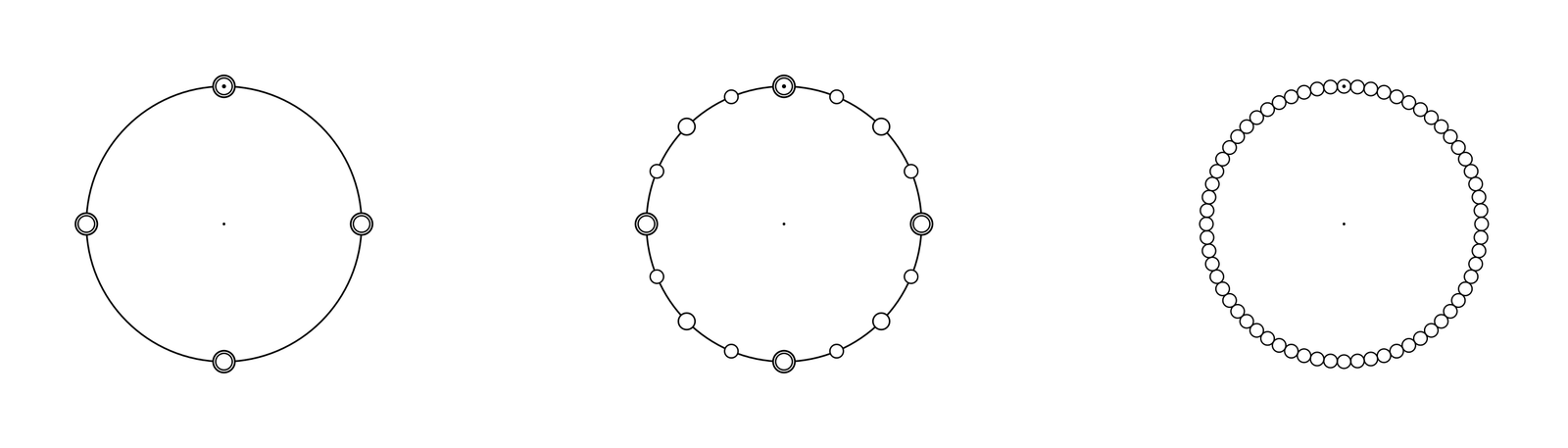
The drawing presents three levels of resolution within one cycle. Four Phases establish its principal divisions. Eight Gongs organize sixteen moments. 64 instants complete the selected temporal resolution.
Each resolution defines a level of measurement and observation within the same cycle. An instant records a position at the selected resolution. When an observed event is assigned to that position, the instant may acquire the status of a moment, a Border-Moment, or another defined Timing.
Circular Mathematics
The Model of Time-Space is based on Circular Mathematics. Its foundational object is the Transcendental Node, introduced in Crystal Basic as:
Transcendental Node is constructed by identifying the two unbounded directions and numerical zero on the extended real line:
𝔗 = ℝ̄ / ∼
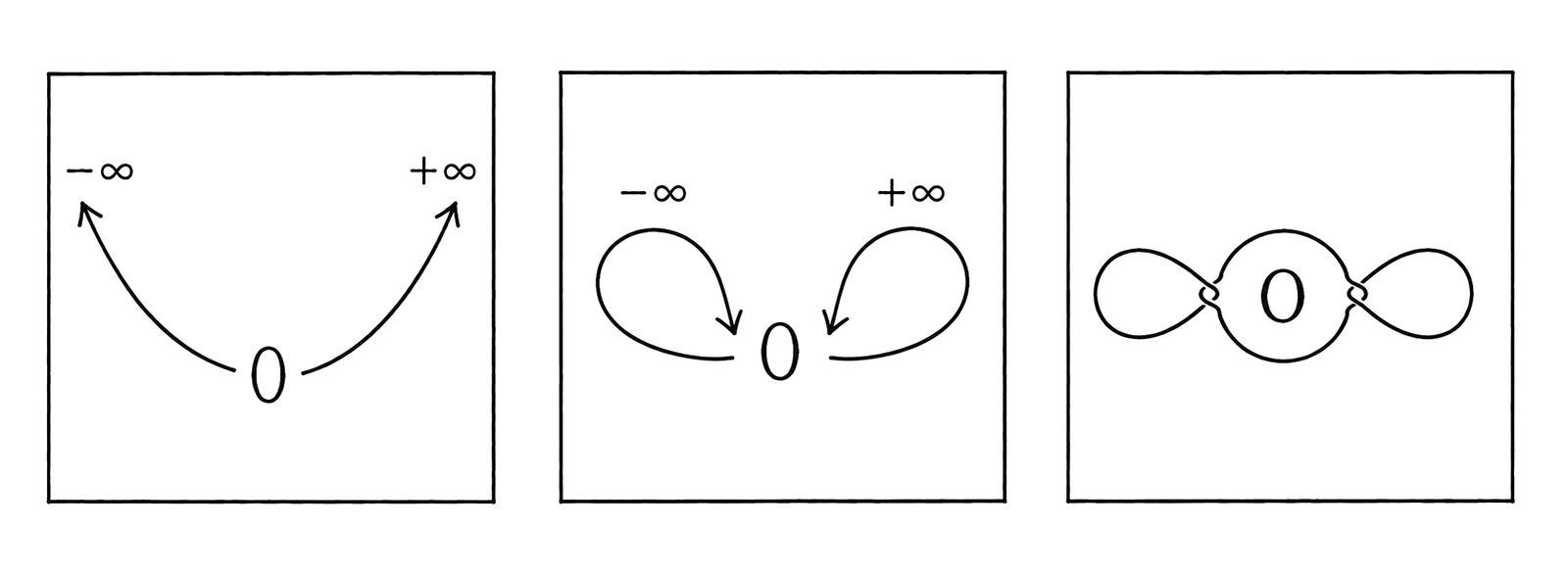
This identifying operation is called knotting. It produces one distinguished structural Origin ⊙ and two complementary loops sharing that Origin:
The complete two-loop structure 𝔗 is Transcendental Node. Circular Time uses one loop as its working circular map, while the complementary loop retains the corresponding reflected construction.
Recursive subdivision gives this map a selected finite resolution N. Its terminal resolved elements are Athoms, represented by Athomic Dots together with their associated cells. [Ma] records the recursive possibility remaining before completion. At the selected terminal resolution:

The complete construction of Transcendental Node, Origin, the Circular Realm, Athoms, and [Ma] is presented in Circular Mathematics.
Axioms of Circular Time
(*) The Circle with No Operative Zero or Infinity
The circle is the basic computational space of Circular Time. Circular Time does not use zero or infinity as operative numerical values in its computations.
Every construction begins with finite distinction and proceeds through a selected finite resolution.
The structural Origin ⊙ is the invariant position
of joining, departure, return, and possible renewal.
There is only one Origin ⊙ per circle / ring / cycle.
[Ma] represents the required recursive possibility that remains unresolved relative to the selected terminal resolution. In [Ma]ₙ =" 0", zero declares the completed status of the defined construction. [Ring of Athoms] = "1" - the cycle is completed.
The symbols −∞ and +∞ may identify unbounded directions brought into structural relation with the Origin. Infinity does not enter the computation as a numerical value.
(**) Determined Rotation
The circular structure has no arbitrarily pre-assigned direction. Before a computation or observation begins, its rotation is determined from the conditions of the operation and its frame of reference.
6 — clockwise rotation
9 — counterclockwise rotation
Once determined, the rotational direction remains fixed for that operation unless an explicit transformation changes or reverses it. Rotation supplies the directional arrow of Circular Time.
(***) Closure and Temporal Extent
Every defined cycle of Circular Time operates at a selected finite resolution and closes by returning to its structural Origin.
The temporal positions of the cycle are represented by Dots with thickness. Their thickness gives them positive represented extent and may carry information about temporal duration, intensity, or significance.
The structural Origin remains thicknessless, even when a terminal Dot occupies the same represented position at the completion of the cycle.
(****) Timing and the Mapping of Events
The structure of Circular Time serves as a map upon which observed events may be placed and compared.
An instant records a position at the selected resolution. A moment is a position defined by an observed event or action. A Border-Moment marks a significant transition, boundary, or change.
A Timing is the operational unit created when an observed event is placed upon the structure of Circular Time.
Crystal Timings
The first working alphabet of Timings uses the two determined rotations, 6 and 9, across six positions. Its structural reference is the binary construction of the I Ching.
The resulting 64 Crystal Timings are developed as complete Sets in Crystal Basic.
Axiom of the Gate
(*****) Conditional Gate
The completion of a temporal cycle permits the possible generation of a Gate.
Closure is necessary for the Gate. The Gate is generated when the additional conditions defined for the operation have been satisfied.
When generated, the Gate may permit passage to another level of computation, another level of observation, another cycle or resolution, or another level of organization within the model.
The generating conditions and the requirements for passage remain under investigation.
Space
The second construction of the model begins with four elementary spatial signs:
Their structure takes inspiration from the genetic alphabet. Four elementary signs arranged across three ordered positions produce 64 possible spatial configurations.
The signs α, β, γ, and δ provide the provisional coordinates of the spatial construction. Their specific operational meanings will be established through the development of the model.
The complete spatial alphabet is developed as a Set in Crystal Basic.
Status of the Model
The present section establishes Circular Time, its finite resolutions, its rotational Timings, the conditional Gate, and the provisional spatial alphabet.
The next section begins the construction of the relation between Time and Space.
The use of round brackets, square brackets, braces, and angle brackets follows the established grammar of Crystal Basic.
Bio-world
[Submenu 3 – content to be inserted]
TS Crystal Basic
[Submenu 4 – content to be inserted]
[Gate]
[Submenu 5 – content to be inserted]
Communications
[Submenu 6 – content to be inserted]
[MAGE]
[Submenu 7 – content to be inserted]
Crystal Dolphin Human
[Submenu 8 – content to be inserted]